The Canada Flexible Office Market Report is Segmented by Type (Co-Working Spaces, Serviced Offices / Executive Suites, and More) by Sector (Information Technology (IT and ITES), and More), by End Use (Enterprises, Freelancers and Start Ups & Others), and by Province (Ontario, Quebec, British Columbia and More). The Report Provides Market Size and Forecasts in Value (USD) for all the Above Segments.
Canada Flexible Office Space Market Analysis by Mordor Intelligence
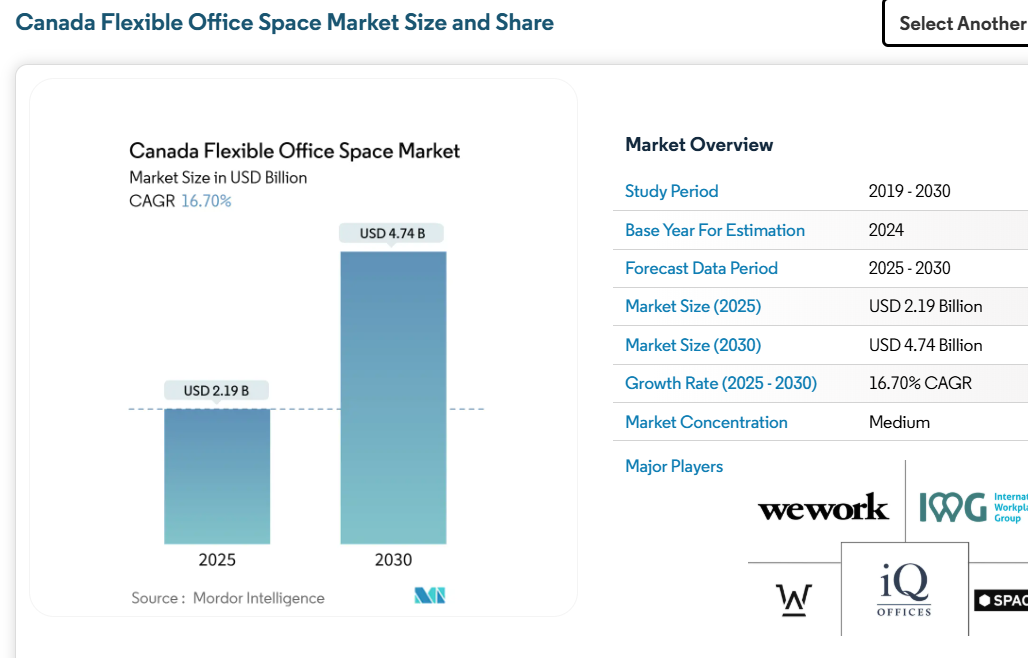
The Canada Flexible Office Space Market size is estimated at USD 2.19 billion in 2025, and is expected to reach USD 4.74 billion by 2030, at a CAGR of 16.7% during the forecast period (2025-2030). Accelerated adoption of hybrid work policies, the push for real-time space utilization data, and the rise of asset-light partnership models are reshaping workplace strategies across provinces. Demand is no longer confined to cost-conscious startups; large enterprises now integrate flexible space into core portfolios to boost talent retention and operational agility. Technology-enabled services, green certifications, and provincial diversification help operators counter rental inflation in core cities. Consolidation—best illustrated by CBRE’s USD 800 million purchase of Industrious—confirms investor confidence in the Canada flexible office space market.
Key Report Takeaways
- By type, co-working led with 49.1% of Canada flexible office market share in 2024, while hybrid and virtual office solutions are forecast to grow at a 17.85% CAGR through 2030.
- By sector, information technology accounted for 31.2% of Canada flexible office market size in 2024; business consulting and professional services show the fastest expansion at an 18.12% CAGR to 2030.
- By end user, enterprises held 52.3% of Canada flexible office market size in 2024, but startups and emerging firms will advance at an 18.75% CAGR through 2030.
- By province, Ontario captured 41.1% of Canada flexible office market share in 2024, whereas Alberta is set to expand at a 19.10% CAGR up to 2030.
Hybrid Work Mandates Drive Financial-Sector Transformation
The evolving workplace dynamics are driving significant changes in real estate strategies across industries. Banks and insurers are reshaping their real estate portfolios, focusing on two-to-three-day office mandates that necessitate compliant satellite spaces for secure collaboration. Flexible-office providers are now offering branded, access-controlled suites that adhere to regulatory standards, alleviating risk concerns for their highly regulated clientele. The endorsement from GCcoworking, a federal entity, adds an extra layer of credibility to these shared environments. Consequently, the flexible office market in Canada witnesses a consistent demand from enterprises, with operators clinching long-term contracts in suburban areas.
Tech-Startup Migration Accelerates Coworking Adoption
The flexible office market in Canada is undergoing a significant transformation driven by evolving business needs. Vancouver’s nascent firms are moving away from traditional leases, opting instead for coworking memberships that align with their venture-funding milestones. These shared spaces have evolved into informal networks for talent acquisition and deal-making, enhancing their allure. Echoing this trend, Calgary and Toronto showcase how fiscal prudence and networking benefits are driving Canada’s flexible office market. This shift underscores the growing importance of adaptability and collaboration in the modern workplace landscape.
Enterprise Desk-as-a-Service Models Reshape Corporate Real Estate
The concept of flexible workspaces is transforming how large organizations manage their office needs. Large organizations are now viewing workspaces as subscriptions, allowing them to free up capital and manage occupancy fluctuations. At Ottawa’s Vanguard Building, corporates are testing the waters with sophisticated booking tools, zero-trust security measures, and trials of unassigned seating. These pilot programs are not just experiments; they validate the demand for premium, tech-driven solutions in Canada’s flexible office market.
Secondary-City Expansion Creates Geographic Diversification
The shift toward suburban markets is gaining momentum as operators adapt to evolving workplace trends. Operators are expanding into Ottawa, Calgary, and Halifax, aiming to be closer to employees and to take advantage of more affordable real estate. IWG’s ambitious “15-minute city” initiative, which seeks to boost Canadian locations from 150 to 250, highlights a strong belief in the rising demand for suburban spaces. This geographic diversification not only protects revenues from the unpredictability of downtown markets but also widens the potential customer base. These strategic moves reflect a proactive approach to meeting changing market demands while ensuring sustainable growth.